


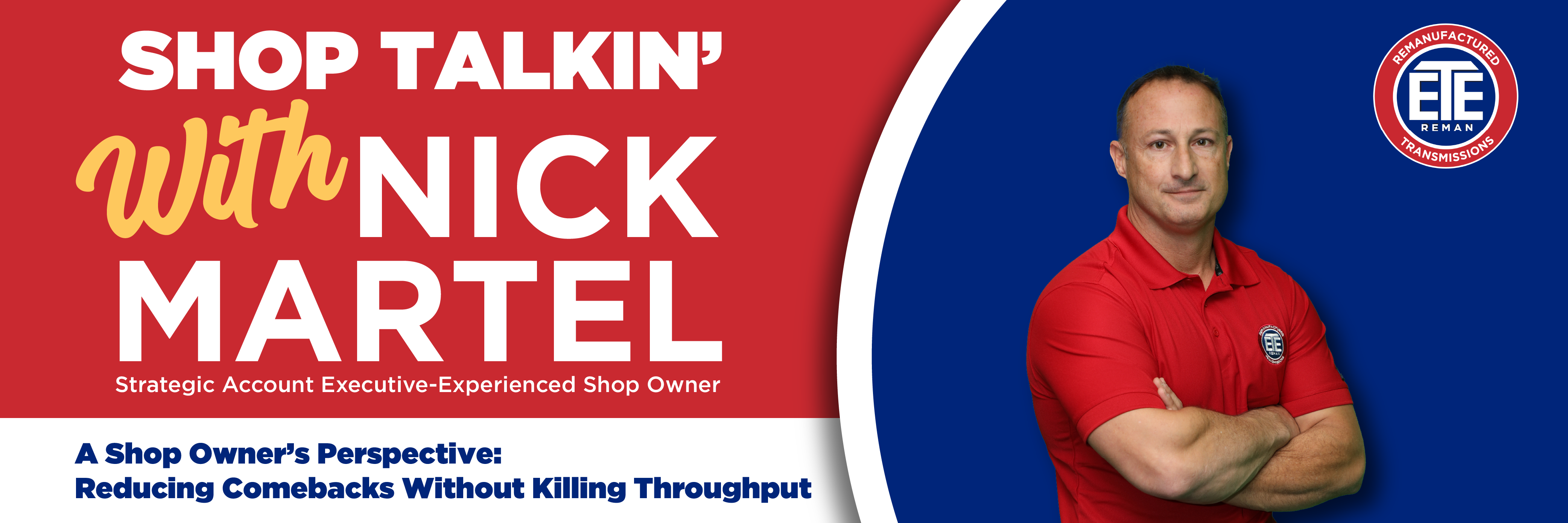
Comebacks are part of the business. Experienced shop owner and ETE REMAN Strategic Account Executive, Nick Martel knows this better than anyone.
No matter how good your team is, how experienced your techs are, or how dialed your process feels, something will eventually come back. The goal isn’t perfection. The goal is minimizing how often it happens… and limiting the damage when it does.
Because if you’ve run a shop long enough, you know this:
A single comeback doesn’t just cost you the repair. It costs time, momentum, and margin you don’t get back. Not to mention the customer trust that gets eroded.
Over the years, I learned that reducing comebacks isn’t about working faster or slower. It’s about building systems that protect both your throughput and your sanity.
It Starts Before the Car Ever Hits the Bay
One of the biggest mistakes I see shops make is treating intake like a formality.
It’s not. It’s the foundation of the entire repair.
The first conversation with the customer sets the tone, and more importantly, gives you the “story” you’ll rely on later. If that story is incomplete or vague, your tech is already at a disadvantage.
In my shop, we got intentional about asking the right questions:
Simple questions, but they matter.
Because a comeback often starts with a missed detail at the front counter, not a mistake in the bay.
Diagnosis: Give Your Tech the Full Picture
A good tech can figure out a lot. A great process makes sure they don’t have to guess.
We made it a rule: the technician should have more information than they think they need.
That meant:
And here’s the key: write everything down.
Not because you’ll need it every time, but because the one time you do, it’ll save you hours.
Accurate diagnosis is one of the biggest comeback killers there is.
The Repair Phase: Where Profit Is Won or Lost
Once the job is approved and the car is in the air, the pressure kicks in.
You’ve got a bay tied up. A customer waiting. A clock ticking.
This is where I saw a lot of shops (including my own, early on) create their own problems.
A few habits made a big difference for us:
1. Don’t tear down until parts are ready
Nothing kills throughput like a disabled vehicle sitting on a lift waiting for parts. We called those “wounded soldiers,” and they back up your entire shop.
2. Communicate immediately when something changes
If you find additional issues mid-repair, stop and get authorization. Don’t finish the job and hope to have the conversation later.
3. Slow down where it matters
Beating book time feels good until you have to do the job twice.
4. Sweat the details on installs
This is especially true for transmission work:
A lot of comebacks aren’t major failures. They’re small misses that stack up.
The Step That Saves You: The Recheck
This is the step most shops skip when they’re busy, and it’s the one that saves the most headaches.
After the test drive, put the vehicle back on the lift and have a second set of eyes look it over.
Not a quick glance. A real check.
That second inspection catches things you won’t see the first time. It’s one of the simplest ways to prevent a vehicle from coming right back.
When Things Don’t Go Right
Even with solid processes, you’ll still have “no-go’s.”
And this is where your business model really shows.
When we built everything in-house, a no-go meant:
You’re running tests, dropping pans, making calls, second-guessing everything. It adds up fast.
When I shifted to a hybrid approach (building some units and sourcing others from a reman partner like ETE REMAN), things changed.
If we had an issue with a sourced unit, the process was different:
Instead of one job stalling everything, we could control the schedule and keep other work flowing.
That’s a big deal when you’re trying to protect throughput.
Comebacks vs. Throughput: You Don’t Have to Choose
There’s a mindset out there that you have to pick one:
In my experience, that’s not true.
The shops that perform best do both by relying on:
Because here’s the reality:
Comebacks don’t just hurt profit; they choke your capacity.
Every hour spent reworking a job is an hour you can’t bill to something new.
Final Thought
At the end of the day, this business comes down to trust.
Your customer trusts you to fix their vehicle.
Your team trusts your process to support them.
And you need to trust that the work leaving your shop is solid.
The systems you put in place, from the first phone call to the final recheck, are what make that possible.
Stick to them. Don’t cut corners when things get busy. That’s when they matter most.
Because the goal isn’t just fewer comebacks.
It’s a shop that runs smoothly, stays profitable, and doesn’t burn you out in the process.
Comebacks are part of the business. Experienced shop owner and ETE REMAN Strategic Account Executive, Nick Martel knows this better than anyone. No matter how good your team is, how experienced your techs are, or how dialed your process feels, something will eventually come back. The goal isn’t perfection. The goal is minimizing how often […]
A new way for ETE REWARDS members to earn more, while getting the 6-speeds they need. Now through the end of March, ETE REWARDS members can earn 2X ETE REWARDS points when purchasing three of the most in-demand transmissions in the industry: the 6R80 and 6T70/75E. It’s a new promotional benefit designed to help […]
I didn’t learn the value of a strong warranty from a brochure.I learned it the hard way: owning a shop, watching margins disappear after a single comeback, and realizing that one transmission job could either strengthen my month… or wreck it.If you run a shop, manage a parts operation, or maintain a fleet, you already […]